Royal Charleroi Sporting Club

Royal Charleroi Sporting Club: Creating a Stronger Fan Journey from First Visit to Reactivation

By centralizing its fan data and automating its CRM communications, Royal Charleroi Sporting Club can now engage supporters based on their level of engagement, from their first match to becoming a season ticket holder.

Use case Royal Charleroi Sporting Club

A Club Deeply Rooted in Its Community

Founded in 1904, Royal Charleroi Sporting Club (RCSC) is an institution deeply rooted in the Hainaut region. Nicknamed Les Zèbres in reference to its black-and-white colors, the club has built a lasting bond with a supporter community deeply attached to its identity and traditions.

For RCSC, strengthening this relationship is not simply about filling the stadium on matchdays. The aim is to understand how each fan’s relationship with the club evolves over time: from discovering the club and attending a first match to becoming a regular visitor and, potentially, a season ticket holder.

This vision led the club to develop a structured fan journey, enabling it to adapt its CRM communications and activations to each stage of the relationship.

The Challenge: Turning Disconnected Interactions into a Coherent Fan Journey

A fan interacts with the club through multiple touchpoints, including ticketing, the online store, access control, cashless payments, and marketing campaigns. When this information remains distributed across separate systems, it becomes difficult to understand exactly where each supporter is in their relationship with the club. Yet a first-time buyer, a regular attendee, a potential season ticket holder, and an inactive fan should not all receive the same message.

Royal Charleroi Sporting Club therefore wanted to move beyond broad, generic communications and deliver more relevant communications at the right time.

The project was designed around three operational objectives:

  • Welcoming and reassuring new spectators before their first visit

  • Recognising when fans are ready to commit and guiding them towards a season ticket.

  • Automatically reactivating fans whose relationship with the club was beginning to decline

By centralizing its data in Arenametrix, the club was able to bring the information available across its different systems into unified fan profiles and build segments based on actual behaviors.

The CRM Strategy: Adapting Communications to Each Stage of the Fan Journey

RCSC organized its CRM strategy around three key moments in the fan lifecycle: the first match, the path to becoming a season ticket holder, and reactivation. This approach enables the club to automatically trigger relevant communications whenever a fan enters a predefined segment, without requiring the marketing team to manually prepare a new campaign each time.

Making the First Match the Beginning of a Lasting Relationship

As soon as someone purchases their first ticket, they enter an automated welcome journey. They receive an email bringing together all the practical information they need to prepare for their visit, including directions and parking, what to expect at the stadium, and useful matchday advice. The aim is to reduce the uncertainty that can accompany a first visit and make the experience as straightforward as possible.

The message also creates an initial opportunity to generate value beyond ticketing. A feature promoting the club store encouraging the supporter to pick up club merchandise ahead of their first match, complements the welcome content.

Thanks to this automated journey, RCSC can provide every first-time visitor with the same level of guidance and support without increasing the operational workload of its marketing team.

However, the objective goes beyond delivering a positive first experience. The club also wants to make that first match the starting point of a more regular relationship.

Turning a First Game into a Habit 

The welcome journey delivers its greatest value when it encourages first-time visitors to return and gradually attend more regularly.

With the actions implemented by RCSC, 46% of spectators who attended their first match subsequently returned for one or more additional fixtures. This result shows that a first purchase does not have to remain an isolated interaction. When it is incorporated into a structured journey, it can become the first step in a lasting relationship. As attendance frequency increases, the club can then identify the fans most likely to deepen their commitment.

Using Behavioral Segmentation to Strengthen Season Ticket Campaigns

Once the first match has passed, attendance frequency becomes a central indicator of fan engagement. For RCSC, the challenge is to identify which supporters are developing a more regular relationship with the club and may therefore be ready to take the next step.

Refining Targeting to Convert Engaged Fans More Effectively

Attendance frequency provides a particularly valuable signal. It enables the club to distinguish occasional spectators from those whose behavior suggests they may be ready to make a longer-term commitment.

The club first ran a season ticket campaign targeting all eligible contacts in its database, meaning those who had provided the necessary consent to receive marketing communications. This initial activation provided a benchmark against which a more targeted approach could be measured.

A second campaign was then sent specifically to fans who had attended at least three matches during the season. Rather than addressing a broad audience, the message targeted supporters whose attendance already showed a clear and growing commitment to the club.

This more focused targeting significantly improved campaign performance :

  • Email open rate increased from 20% to 32%

  • More than one in five recipients who opened the email went on to purchase a season ticket

  • The segmented campaign therefore generated a conversion rate approximately eight times higher than the broader send

For RCSC, the value of this result extends beyond the performance of a single email. The campaign demonstrates how a straightforward behavioral data point, in this case the number of matches attended, can help the club identify the right target and encourage a longer-term commitment.

Using SMS in the Final Days to Drive Season Ticket Sales

To complement the initial sales phase, the club launched an SMS campaign during its final two days.

At this stage, the objective was no longer to introduce the season ticket offer. It was to remind undecided fans of the offer as the deadline approached and make it easier for them to act.

In just two days, the SMS campaign generated :

  • 293 season ticket sales 

  • more than €60,000 in revenue

At the end of this first sales phase, RCSC had approximately 3,500 season ticket holders. This single activation therefore accounted for 8.4% of the total.

The campaign illustrates the complementary role of different channels within a well-orchestrated CRM journey. Email gives fans the detail they need to consider the offer, while SMS provides a timely final prompt when the deadline is close.

Automatically Reactivating Inactive Fans

Not every supporter follows a linear journey. Some begin attending less frequently, stop making purchases, or no longer engage with the club’s communications. For RCSC, a drop in activity does not necessarily mean the relationship is over. Instead, it is a signal that should be detected early enough to create an opportunity to reconnect.

The club therefore introduced two complementary reactivation journeys :

  • The first targets supporters who have not purchased a ticket for more than six months.

  • The second targets contacts who, over the same period, have neither opened nor clicked on any marketing communication.

This distinction allows the club to adapt its approach according to the nature of the disengagement. A fan may continue following club news without purchasing, while another may have stopped interacting with the club altogether.

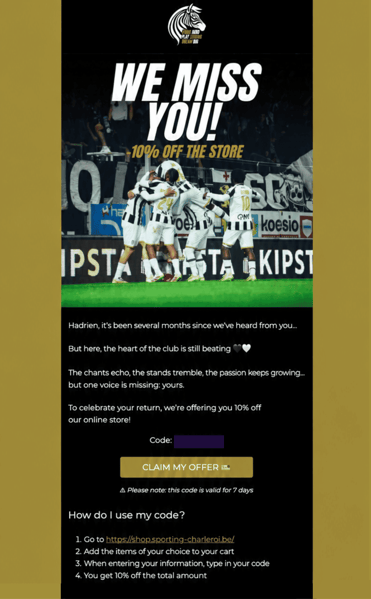
Reengaging Inactive Fans Through Automated JourneysCampagne réengagement Charleroi EN

To reengage these inactive contacts, RCSC created communications offering a promotional code for the club store or a match ticket, depending on the type of inactivity identified.

The journey runs automatically. As soon as a contact meets the inactivity criteria defined by the club, they enter the workflow.

Once the journey has been configured, this revenue is generated without any additional operational effort from the marketing team. Over a six-month period, this activation generated approximately €20 in revenue per reengaged contact

However, the value of the initiative extends beyond the sales directly attributed to the campaign. When these supporters make another purchase or book a match, they become active in the club’s CRM journey again.

RCSC can once again observe their behavior, enrich their profile, and continue the relationship with communications tailored to how they now interact with the club. The journey therefore does more than recover occasional revenue. It turns a period of inactivity into an opportunity to reconnect with the supporter.

The Key Components of RCSC’s Fan Journey

Centralizing Fan Data
Data from the club’s different touchpoints is brought together to give the club a clearer view of each supporter and their relationship with RCSC.

Segmenting Fans According to Real Behaviors
First purchases, attendance frequency, purchase inactivity, and declining marketing engagement can be used directly to build relevant CRM segments and trigger campaigns.

Automating Key Moments
Welcome and reactivation communications are triggered automatically whenever the conditions defined by the club are met.

Coordinating Multiple Channels
Email supports the main stages of the fan journey, while SMS complements campaigns when an approaching deadline requires a more immediate message.

A CRM Strategy Built Around the Fan Journey

By structuring its activations around the fan lifecycle, Royal Charleroi Sporting Club has moved from a series of one-off campaigns to a continuous CRM strategy. Every interaction can now help determine the next most relevant action: preparing a fan for their first visit, encouraging them to return, offering a season ticket to a regular attendee, or reconnecting with an inactive supporter.

Arenametrix provides the data centralization, segmentation, and automation infrastructure required to deploy this strategy.
RCSC defines how the strategy is applied in practice. The club determines the key moments, the audiences to engage, and the experience it wants to deliver throughout the fan journey.

Thanks to Arenametrix, we can now better understand our fans’ journeys and engage them in a more personalized way at every stage of their relationship with the club.
Pongoli Mario, Responsable Marketing Digital