%20copie.png?width=60&height=60&name=baptiste%20(2)%20copie.png)
With Arenametrix Ecosystem Talks, Arenametrix continues its interview format dedicated to the people and companies shaping the future of audience engagement across sports, culture and entertainment.
The aim is to open the conversation with complementary players in the market — from ticketing and fan engagement to gamification, digital consulting, sponsorship activation and audience experience — and explore how technology, data and partnerships can help organisations create more value for their audiences.
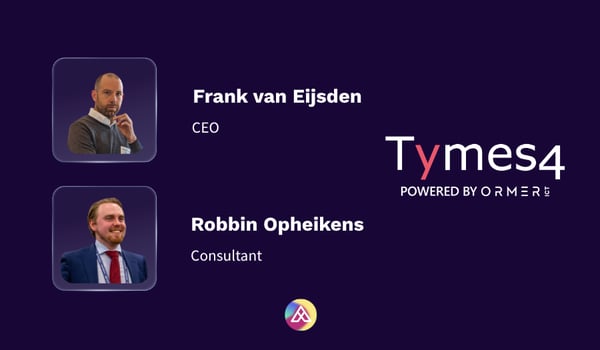
For this edition, Baptiste Sauvanaud, Sport Marketing Lead & Partnership Enablement at Arenametrix, spoke with Frank van Eijsden, CEO of Tymes4, and Robbin Opheikens, consultant at Tymes4, about the changing role of ticketing in professional football: from a transactional system to a strategic component of the fan journey.
Frank brings deep experience in football ticketing and club-side operations. From 2006 to 2012, he worked as Ticketing Manager at Feyenoord Rotterdam, before becoming Manager B2C Sales at the club until 2018. He joined Tymes4 as COO in 2020 and became CEO in 2024.
Robbin recently joined Tymes4 as a consultant after working as B2C Sales Marketeer at Excelsior Rotterdam. In his current role, he works closely with clients’ ticketing teams to help them get the most out of the Tymes4 software.
Tymes4 is a Dutch ticketing technology company focused primarily on professional football clubs. The company develops a specialised ticketing platform and, according to Frank, currently works with over 80% of professional football teams in the Netherlands. Tymes4 and Arenametrix also have an operational integration at Willem II, their first joint client.
Tymes4 is a Dutch ticketing technology company focused primarily on professional football clubs. The company develops a specialised ticketing platform and, according to Frank, currently works with over 80% of professional football teams in the Netherlands. Tymes4 and Arenametrix also have an operational integration at Willem II, their first joint client.
This interview has been edited for clarity and length.
Tymes4 focuses on professional football. Why this specific positioning?
Baptiste: Tymes4 is positioned specifically around professional football. In your view, is there a real difference between professional football and professional sports clubs in general?
Frank: Yes and no. It depends on the context.
What we see is that, in Europe, professional football clubs are generally much larger than organisations in many other sports. They often have more scale, more resources and more specific needs. That is where we believe we can add the most value.
That does not mean we would automatically say no to a major rugby club in France, for example. We are open to relevant opportunities. But our core focus and development effort is professional football.
Football clubs tend to be more professionalised in the way they approach innovation and digital maturity. They also have large fan bases and specific operational requirements. That is why we focus on this area.
For us, the objective is not to cover every sport or every country in the same way. We only deliver ticketing functionality, and we want to adapt our solution to the specific needs of each market. We would rather work with several clubs in one country, understand that market properly, and optimise the product accordingly.
What works in the Netherlands does not necessarily work in Belgium or France. There are things you can learn from each market, but you need to adapt to local circumstances. That is where localisation becomes important.
Baptiste: That makes sense. Football clubs often have a higher level of digital maturity than other sports, with more resources in terms of budget and people.
Frank: Exactly. We position ourselves as a best-of-breed ticketing provider. We only do ticketing, but that means we need to integrate with many other systems used by clubs: CRM, single sign-on, apps, accounting systems and more.
Professional football clubs use a lot of different software solutions. The role of ticketing is to integrate properly within that environment.
How is the role of ticketing evolving in professional sports?
Baptiste: Ticketing has historically been seen as a transactional system. In professional sports today, its role seems to be evolving within a broader fan journey, fan engagement and data strategy. How do you see this evolution?
Frank: We believe ticketing is becoming more like an engine running in the background.
Today, if a club wants to sell tickets, fans are often sent to a ticket shop. If the club wants to sell merchandise, fans go to a merchandise webshop. But in the future, ticketing will increasingly become a transactional engine running behind the scenes, while the user-facing experience is designed elsewhere.
If ticketing is part of the fan journey, then the ticketing supplier should not necessarily determine what the interaction looks like. Otherwise, the ticketing experience remains different from the merchandise experience, the app experience or the broader club experience.
In the end, I think clubs will want to design their own front-end screens and fan journeys. Ticketing will run in the background and come to the front only when needed.
That is why we focus strongly on native experiences. We do not believe the future is simply a mobile-friendly ticket shop. Of course, we have one, but we would rather see an app provider integrate our SDK (Software Development Kit) and offer a fully native ticketing experience inside the club app.
Ticketing is part of the fan journey, but clubs will increasingly design their own flows. For example, if a fan needs to select a specific seat, the ticketing interface may need to appear. But different sales flows for different people and different matches should be defined by the club.
Even when ticketing runs in the background, the relevant data still needs to be available to the relevant partners. It is not just a machine processing transactions. It also needs to provide the right data to other systems.
What new fan engagement and revenue models are emerging?
Baptiste: Beyond the transaction itself, how do you see ticketing supporting new fan engagement and revenue models?
Robbin: In the Netherlands, we see that many clubs are selling out their stadiums. Beyond trying to expand stadium capacity, they are also looking for new ways to increase revenue from a fan perspective.
One area that is getting more attention is membership. It can become a layer on top of the season ticket, which has traditionally been the main loyalty product. I think clubs will continue exploring that type of model.
Frank: Yes, and that is especially important for Dutch clubs, although we also see it in other markets.
From a functional ticketing perspective, I think the future will involve more recombination of products and the creation of new product types. That could mean a season ticket combined with a membership, but it can take many forms.
Clubs are starting to do this more, especially in Belgium and the Nordics, where some teams are already advanced. But I think this is only the beginning.
If a stadium is sold out, it is a bit old-fashioned to think only in terms of season tickets covering most of the stadium. That also means that only part of the fan base actually gets to attend. Clubs often want to engage a broader audience and bring more people to the stadium more regularly. That requires new products.
What role should ticketing play in fan data?
Baptiste: At Arenametrix, we often look at fan engagement from two perspectives: bringing more value to the fan through better journeys, and helping clubs use audience knowledge to create more value, including for sponsors. How do you see the role of ticketing in that broader fan data ecosystem?
Frank: There is an interesting shift happening around fan data.
Today, CRM, ticketing, single sign-on and merchandising data are often pushed around continuously between different systems. As integrations become deeper, the role of the ticketing system also changes. We still need access to the right information, but we do not necessarily need to become the place where all fan data is stored.
That is what we mean by “dataless ticketing”: not ticketing without data, but ticketing that can keep delivering its core functions while relying on connected systems, such as CRM or single sign-on, for the fan data they already manage.
If you look at GDPR and data minimisation, that is the principle. If the right integrations are in place, it should not be mandatory for the ticketing system itself to operate on a full fan database.
The challenge is to continue offering all ticketing functionality without needing to hold all the data ourselves. That is where we believe the market is heading.
How can technology providers work better together?
Baptiste: Football clubs are a niche market, and partnerships between technology providers seems like a solution to innovate and deliver more value. From a governance and organisational point of view, how can clubs encourage their different providers to work together more effectively?
Robbin: One example that comes to mind is Club Brugge KV in Belgium. From what I understand, they seem to have an internal structure that sits above their different providers, instead of each provider working separately.
I think that type of umbrella structure will become more important in the future. Clubs need a way to coordinate the different systems and providers involved in the fan journey.
Frank: I agree. What often holds back innovation is that clubs do not always take the initiative to bring their important suppliers together and think with them.
Technology providers can build strong modules and invest a lot of resources, but if no club uses them or helps create a showcase, then it becomes difficult to justify that investment.
Innovation also depends on the ownership clubs take. Creating opportunities between partners should involve clubs. Clubs need to explain what they believe will be important in the near future and invest in building showcases together.
Baptiste: That is also something we often advise clubs to do: identify someone internally who can act as an ambassador of the fan journey.
In many clubs, you have commercial, sponsorship, ticketing, communication and digital teams working separately. Having someone who can connect these teams, understand what is happening across the organisation and steer them in the same direction can make a real difference.
We also see that centralised initiatives can help. For example, when a league helps clubs structure RFPs around different components of the tech stack, it can help smaller clubs align their approach and build a more coherent strategy around data, ticketing and the fan journey.
Frank: Yes, I think that drives progress. If clubs work together, or if a central organisation creates structure around these topics, it helps.
That is especially true for smaller teams. Bigger clubs often know what they want and have their own roadmap. Smaller teams can really benefit from centralised approaches and initiatives.
What will define the future of ticketing?
Baptiste: Looking ahead, what do you think will define the future of ticketing in sports? Better user experience, smarter pricing, personalisation, deeper integrations, AI, or something else?
Frank: There are several things, and they connect to what we discussed earlier.
First, we will see different flows for different people and different purchases. If there is a cup match and a fan needs to buy back their own seat, why should they have to log in to a ticket shop and manually confirm it? Why not send a push notification in the club app, where they can simply confirm?
That type of flow is coming.
We have seen different waves of technology — blockchain, NFC, now AI — and we believe AI will play a role. One challenge will be detecting good bots from bad bots, because eventually bots may buy tickets for people. The market will need to adapt to that.
When it comes to integrations, we believe clubs should follow a best-of-breed approach. Pricing is a good example. We will not develop pricing software ourselves. If a club wants to use smart pricing, we would rather integrate with an external pricing specialist, because they understand that topic better than we do.
That is our philosophy: we integrate across different topics. These integrations will go further than the APIs that are common today. There will be more SDKs integrated into club front ends and apps.
So the future will bring new ways to integrate ticketing with the different software systems in the club ecosystem.
If you had one practical piece of advice for football clubs, what would it be?
Baptiste: If you had one practical piece of advice for a football club, whether about ticketing or something broader, what would it be?
Robbin: When I was working at a smaller club, I noticed that the priority was often convenience within the organisation.
People did not want to make things too difficult internally by creating more complex products. But when we started to focus less on internal convenience and more on convenience for the customer, we generated more revenue.
So my advice would be to stay flexible in the way you approach your product. Think about different ways to offer your product to different audiences and make it more relevant for them.
Frank: I agree. In other words: try to do new things instead of always doing what you have always done. If you do what you have always done, you get what you have always got.
Experimentation is one piece of advice.
The other point I would add is about how ticketing is positioned inside football clubs. We often see that ticketing is not organised as well as it should be. The question of who is responsible for ticketing is often unclear.
On one hand, ticketing generates significant revenue. For an average club in Western Europe, it can represent around 20–25% of total revenue. On the other hand, it is also a very important touchpoint for the club’s most loyal fans.
So ticketing is commercial, but it is also marketing. It is also technical, complex, software-based and digital. Who should be responsible for it? The IT department? The commercial department? Marketing?
Too often, clubs see ticketing as something simple: “How hard can it be?” But in the end, it is complex. It should be positioned properly within the organisation, and everyone should understand that it is much broader than software alone.
That would be my advice: position ticketing properly.
