The start of a new season is often a race against the clock for marketing and CRM teams. There’s a new programme to promote, acquisition campaigns to launch, newsletters to prepare, ticket sales to drive… In this context, every communication that can be automated means time saved for your teams.
But the challenge is not purely operational. A well-designed marketing automation scenario also makes it possible to send the right message at the right time, based on what you already know about your audience: their purchase history, previous visits, interests and level of engagement.
Here are the 10 scenarios we recommend preparing before the new season begins.
Why is marketing automation particularly useful for museums and performing arts venues?
Because the season won’t wait.
While teams are preparing to launch the new programme, audiences are still signing up, browsing the ticketing site, buying tickets and getting ready for their visit. All these small interactions call for a response, but they don’t necessarily deserve another task on your team’s to-do list.
That’s where automation comes in:
- Someone has just bought a ticket for a show? They should automatically receive the practical information they need.
- They’ve just discovered an exhibition? This could be the perfect time to recommend another one.
- They haven’t engaged with you for two years? A new programme could be the opportunity to bring them back.
Every audience signal creates an opportunity to communicate at the right moment. And when those signals are available in a centralised CRM, the right communications can be triggered automatically.
What marketing automation scenarios should you set up for the new season?
1. Welcome new subscribers
A newsletter sign-up is an important first signal of interest. It deserves more than a simple confirmation message.
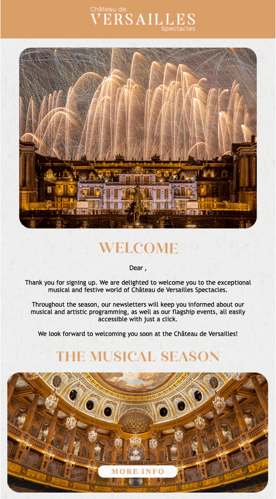
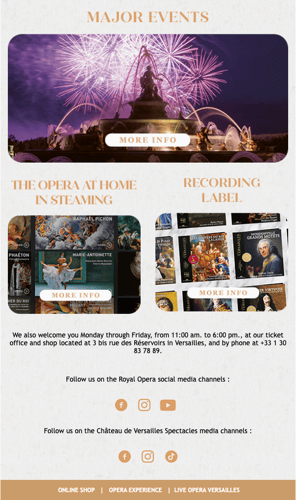
This first email is an opportunity to introduce your venue, highlight the season’s key events, explain what kind of content subscribers can expect, and show them the different ways they can explore your programme.
It’s also an opportunity to start learning more about your audiences. If you already have information about their interests, for example, you can highlight the content that is most relevant to them.
The message is sent automatically as soon as someone subscribes. Your teams therefore have nothing to manage, even when several hundred people join your database during an acquisition campaign.
💜 Our pick: Château de Versailles Spectacles, welcoming new subscribers into their world.
2. Don’t let abandoned baskets slip away
Abandoned baskets are probably one of the most obvious marketing automation scenarios, and one of the most useful.
Someone has selected a show or visit, started the booking process, and then left the ticketing site without completing their purchase.
Perhaps they were interrupted. Perhaps they wanted to think about it. Perhaps they simply closed their browser. Whatever the reason, they had already shown clear purchase intent.
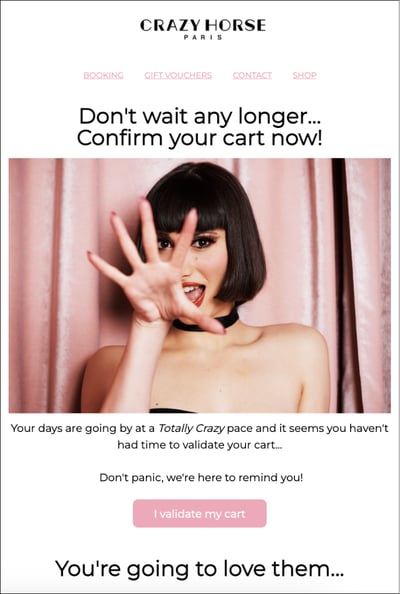
An email sent a few hours later can help them pick up where they left off, without having to start again. The goal isn’t to send another reminder for the sake of it, but to remove friction while purchase intent is still high.
💜 Our pick: Crazy Horse, keeping re-engagement simple and effective.
3. Turn the purchase confirmation into the first step of the experience
Once a ticket has been purchased, the relationship doesn’t end. In fact, that’s where the experience begins.
Your audience will now need practical information: their ticket, timings, access, transport, door opening times, specific instructions and on-site services.
The content should answer the questions people are genuinely likely to have before their visit. For teams, this scenario has a very practical benefit: fewer recurring questions for customer service and better-prepared audiences on the day.
This email can also be used to drive upselling or highlight complementary offers: a guided tour, exhibition catalogue, food and beverage options, parking, and so on.
4. Send the right reminder before the visit or show
As the big day approaches, a simple reminder can prevent a lot of questions, and a lot of stress.
The idea isn’t to resend the purchase confirmation. At this point, audiences mainly need the practical information that will be useful on the day of their visit.
Depending on when the message is sent, SMS can also be a better option for visitors or spectators coming that day: shorter and more direct, it is more likely to be read at the right moment than an email.
The content can also vary according to the audience profile. Someone visiting a performing arts venue for the first time may need more information than a regular attendee. Likewise, a visitor who already knows a museum well won’t need the same level of detail as someone discovering it for the first time.
Marketing automation allows you to manage these differences automatically using the data available in your CRM.
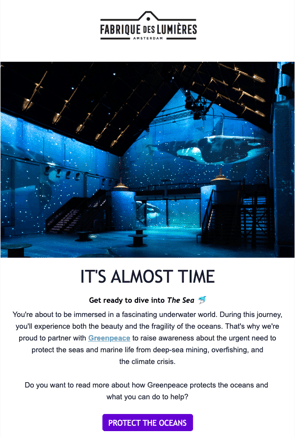
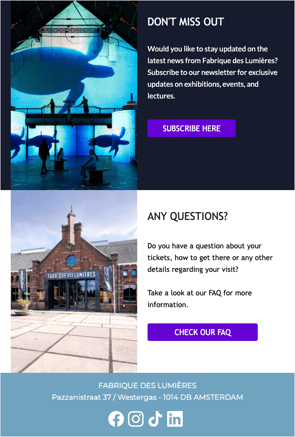
💜 Our pick: Culturespaces, using pre-visit emails to share a dedicated FAQ and enhance the on-site visitor experience.
5. Keep the experience going after the visit
Your audience has just left your museum, theatre or concert venue. What happens next?
This is often where the CRM journey stops. Yet it is probably one of the best moments to communicate again: the experience is still fresh. A thank-you email can do much more than simply say “Thank you for your visit."
A venue could share an artist interview, a podcast or upcoming tour dates. A museum could offer additional content related to an exhibition or introduce upcoming events.
In other words: leaving the venue doesn’t have to mean the end of the audience journey.
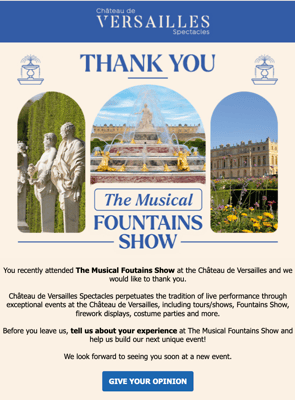
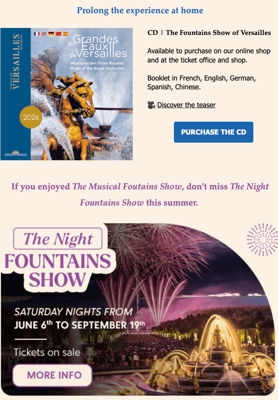
💜 Our pick: Château de Versailles Spectacles, sharing additional content related to its events.
6. Ask your audiences for feedback
Marketing automation isn’t only about promoting the next offer. It can also help you listen.
A few hours or days after a visit or show, a short survey can provide valuable feedback on the experience. But the value isn’t just in collecting responses. What you do with that feedback afterwards is what really matters.
Someone who is highly satisfied could be invited to discover another experience or share their feedback online or on social media. Conversely, negative feedback can trigger a specific communication and, where necessary, be passed on to the relevant team for follow-up.
Feedback then becomes CRM data in its own right, helping shape the next stage of the audience journey.
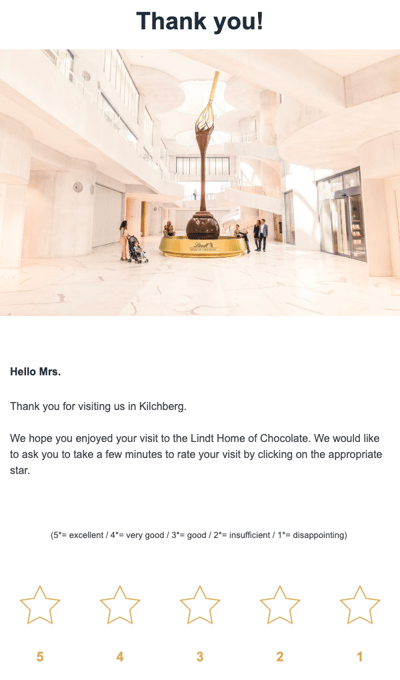
💜 Our pick: Lindt Home of Chocolate, making it easy for visitors to share their feedback with just one click.
7. Recommend the next experience
This is one of the scenarios that best demonstrates how CRM data can translate into a more personalised audience experience.
You know what someone has bought, which events they have viewed, which shows they have attended and which exhibitions they have visited.
So rather than sending them the same programme as everyone else, why not recommend the experiences they are most likely to enjoy?
→ You enjoyed this exhibition? You might also like…
→ You attended this show? Discover these three upcoming events.
Recommendations can be based on genres, artists, themes, events viewed or attendance history.
The idea is simple: use what you already know about your audiences to make your next communications more relevant.
💜 Our pick: Culturespaces, recommending exhibitions based on visitors’ interests.
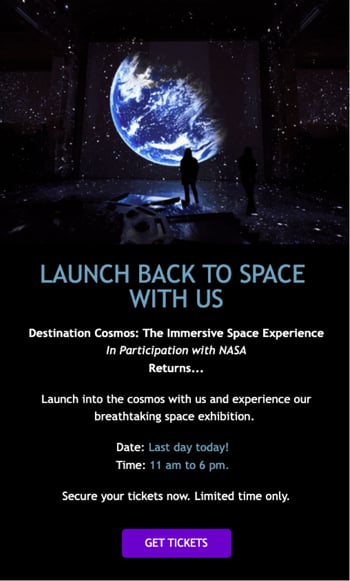
8. Give first-time visitors special attention
A first purchase is a key moment: it marks the beginning of a relationship, but there is no guarantee that the audience member will come back. That’s why it can be worth creating a dedicated journey for first-time visitors.
The idea is simple: make their first experience a success, then give them a reason to return.
Imagine someone visiting a venue for the first time to see an artist. A few days after the show, instead of sending them your general newsletter, you could introduce two or three other shows with a similar appeal. The same principle applies to museums: a first exhibition can become the starting point for a broader discovery of the venue.
The first purchase shouldn’t be seen as an end in itself, but as the beginning of the relationship.
9. Remember birthdays
Birthday campaigns are simple to set up, but they can help maintain the relationship between visits or purchases.
A birthday stored in your CRM can become an opportunity to reconnect in a personalised way. An exclusive benefit, an invitation, a recommendation or simply a personalised message: the choice should reflect your relationship strategy.
Again, there’s no need to send exactly the same message to everyone in your database. A casual visitor, a loyal attendee and a member of a loyalty programme are unlikely to have the same expectations.
10. Re-engage audiences who have drifted away
An audience can remain silent for several months without being permanently lost. The challenge is to spot declining engagement early enough to have a chance of rebuilding interest.
How long should you wait before considering someone inactive? It obviously depends on your attendance cycle. A few months may be a long time for a performing arts venue, but perfectly normal for some museums.
Once you have defined this threshold, a re-engagement scenario can be triggered automatically.
But instead of simply sending a “We miss you” message, ask yourself: what would actually make this person want to come back?
Use the information available in your CRM. Imagine that some of your inactive contacts attended a rock concert last year. A new artist in the same genre is scheduled in two months? That could be the right moment to reconnect with them.
How should you prioritise your marketing automation scenarios?
You don’t need to implement all 10 scenarios at once.
To prepare effectively for the new season, start with the moments when communication volumes are highest and automation can deliver an immediate benefit for both teams and audiences.
The three-step sequence purchase confirmation → pre-visit reminder → post-experience message already provides an excellent foundation.
You can then gradually add abandoned-basket, first-visit, personalised recommendation, satisfaction and re-engagement scenarios.
The key is to build these journeys around signals that are genuinely available in your data: purchases, browsing behaviour, visits, attendance history, birthdays, engagement levels…
Someone has just bought a ticket? They are visiting your venue for the first time? They haven’t purchased anything for 18 months? These signals can become the triggers for your next automation scenarios.
That’s where a platform like Arenametrix really comes into its own: by centralising data from different touchpoints and enabling automated campaigns to be triggered from that information, teams can move from communications driven primarily by the calendar to communications driven more by audience behaviour.
The marketing automation checklist for the new season
Before the season launches, make sure these scenarios are ready:
- Welcome email after newsletter sign-up
- Abandoned-basket reminder
- Purchase confirmation and practical information
- Pre-visit or pre-show email
- First-visit journey
- Post-visit or post-show email
- Satisfaction survey
- Personalised recommendation
- Birthday email
- Re-engagement of inactive audiences
Marketing automation isn’t about automating for the sake of automation.
It’s about identifying the moments when your audiences need information, attention or a new recommendation, and making sure the right communication is sent automatically, without someone having to remember to trigger it every time.
For marketing and CRM teams, the benefit is tangible: fewer repetitive tasks, fewer campaigns to manage manually, and more time to focus on acquisition, retention and audience engagement.
For audiences, the result is just as tangible: more relevant information, delivered at the right time, and an experience that doesn’t end when the ticket is purchased or the show is over.
That is the real purpose of marketing automation: putting your data to work for the audience experience, while giving your teams more time to focus on the work that genuinely requires their expertise.
