In sport and culture, audience engagement is what keeps every season alive. To sustain it, clubs, performing arts venues, festivals and museums rely on a growing number of digital services: ticketing, online shop, mobile app, member or season ticket holder area. To connect these services, single sign-on (SSO), or a single account, has become a strategic lever.
An industry-specific SSO is a single sign-on system designed specifically for one sector. For a sports or cultural organisation, it gives every spectator, fan or visitor one account for ticketing, the shop, the app and the member area, and links every login to the audience database.
When choosing an SSO solution, there are two families of options: generic identity solutions, designed for every sector, and industry-specific SSOs, built around the realities of clubs, venues, festivals and museums. On paper, both let people log in once. In practice, what happens after the login makes all the difference.
What sets a generic SSO apart from an industry-specific SSO?
All SSOs rely on the same authentication standards: OpenID Connect, OAuth2 or SAML. The login technology itself rarely makes the difference. What does is everything around it: what the login is connected to, who configures it and which use cases it was designed for.
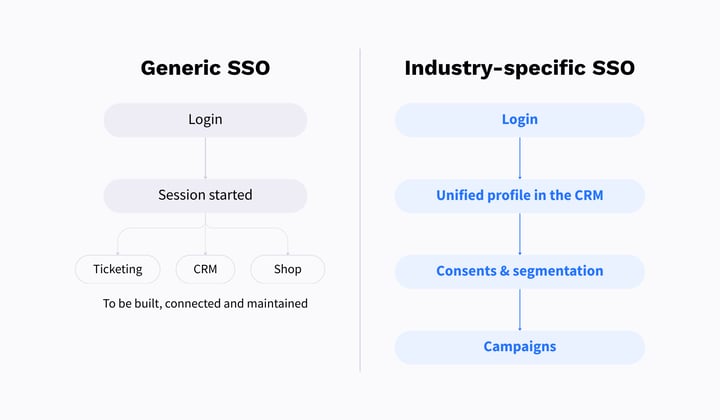
A generic SSO is designed for every sector, and often first and foremost for employee access to a company's internal tools. It verifies an identity and opens a session. For a generic SSO, the login is the end point. Everything else, such as linking the account to ticketing, feeding information into the audience database or syncing consents, has to be built and maintained separately, by a technical team or a service provider with no particular knowledge of your sector.
An industry-specific SSO makes the login the starting point of the relationship. It is built around the realities of sports and cultural organisations and the sector tools it works with every day: ticketing software, online shops, club and venue apps.
This sector expertise changes the nature of the project, and choosing an SSO becomes as much a marketing decision as a technical one. With an industry-specific SSO, a spectator's or fan's profile is created the moment they sign up, before they even reach your database. If their email address is already known, their history is automatically attached. Every detail they update is synced in real time with the platform that centralises your audience data. Your marketing and CRM teams work from a reliable database, without waiting for a technical team to connect the dots.
Industry-specific SSO: 5 reasons to choose an SSO built for sport and culture
1. It fits into your organisation's digital ecosystem
A rugby club doesn't have the same ecosystem as a museum, but both juggle several tools: ticketing, an online shop, an app, and sometimes a content platform or a membership scheme. An industry-specific SSO is designed to connect to exactly these tools. It relies on the standards that ticketing providers and sector suppliers know how to integrate, and lets you attach information specific to your activity to each person's profile.
Above all, your audiences' identity no longer depends on any single provider. If you change ticketing system or app, the accounts, data and journeys stay in place.
In 2025, for example, Rugby Club Toulonnais changed ticketing provider. Thanks to its already structured CRM and SSO ecosystem, the switch had no impact on the club's marketing operations: data stayed centralised, automated journeys kept running and the relationship with fans carried on without a break.
2. Every login enriches your audience database
Emma Clarke has been a season subscriber at her local theatre for three seasons. She bought her first tickets with her personal email address, then renewed her subscription with her work address. In the theatre's database, she exists twice, and neither record tells her whole story.
An industry-specific SSO stops these duplicates at the source. The profile is created at sign-up, the history is attached if the email address is already known, and every update the spectator makes, whether a new address or a new phone number, is synced in real time with your other tools. Every login becomes a chance to update your database, with no dedicated campaign and no re-keying by your teams.
KRC Genk, for its part, combined data centralisation, CRM activation and SSO to build a single fan identity. The Belgian club now has more than 300,000 unified fan profiles (January 2026), and its automated first-visit-to-the-stadium campaign achieves a 42% click-through rate.
3. Your consents are centralised and respected everywhere
When each tool collects its own opt-ins, contradictions creep in. A fan who has unsubscribed from the newsletter keeps receiving offers from the ticket office. A visitor who agreed to receive partner offers when joining doesn't show up as such in the campaign tool.
With an industry-specific SSO, consents are collected at sign-up, clearly, with a date and a full audit trail. Your audiences manage them from a single preference centre in their "My account" area, and every change is automatically passed on to your communication tools. For your teams, GDPR compliance becomes easier to guarantee. For your audiences, it's the certainty that their choices are respected across all your channels.
4. An experience in your colours, from stadium to museum
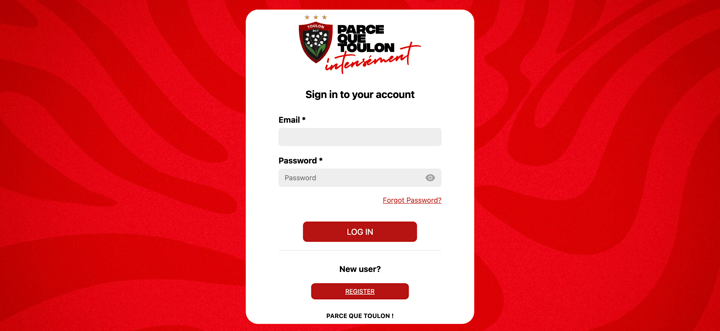
A generic login page, with no connection to the club's website or the season's visual identity, breaks the experience at the very moment people are about to buy. With an industry-specific SSO, the login and sign-up pages and the "My account" area carry your brand identity: logo, colours, fonts, visuals. Account confirmation and password reset emails are customised too, and the interface can be offered in several languages for your international audiences.
5. A launch supported by experts in your sector
Rolling out a single account also means moving thousands of existing accounts to a new login. Even for the biggest clubs, it takes a methodical approach: after launching its SSO in November 2024, Liverpool FC had to set a deadline in March 2026 for fans who had not yet logged in, so they could link their account and keep their ticket and membership history.
With an industry-specific SSO, the launch is prepared with you by teams who know your audiences. Existing accounts are migrated automatically, so nobody starts from scratch. The roll-out can be gradual, by segment (season ticket holders, regular buyers, inactive contacts), to manage the load and encourage adoption. Email templates and announcement pages are provided to introduce the new account to your audiences. Once the SSO is live, the documentation and admin console let your teams help a fan who can't log in themselves.
Union Bordeaux Bègles launched its single account with Arenametrix on 14 April 2026, after almost two years of working together on structuring its CRM and data. On day one, the club recorded 10,000 logins: that many active, up-to-date profiles, ready for season ticket renewal reminders and reactivation campaigns.
Why opt for a specialist SSO?
A specialist SSO does far more than open a session. It fits into your organisation's digital ecosystem, turns every login into reliable data, centralises consents, extends your brand identity right into your audiences' personal area and is rolled out with support from people who know your seasons. In other words, it makes the single account the gateway to your entire relationship with your audiences.
That's the approach behind Arenametrix's SSO, built by and for sports and cultural organisations, like the rest of our Audience Data Platform. It runs on Keycloak, a proven open-source identity technology used by large companies, and on the OpenID Connect and SAML standards. Above all, it is natively connected to the platform that already centralises your ticketing, shop, app and access control data through more than 160 integrations. Every profile created at login goes straight into your unified database, ready to be segmented and activated in your campaigns.
And you're not on your own: our teams support you from scoping the project right through to announcing the launch to your audiences. Rugby Club Toulonnais, Union Bordeaux Bègles, LOU Rugby, Valenciennes FC, Lausanne Hockey Club, KRC Genk and Rugby Europe have already made this choice to turn one-off transactions into a direct, lasting relationship with their audiences.